
“Do not be afraid of shadows. They simply mean there’s a light shining nearby.”
–Ruth E. Renkel (1918–1983), American Writer and Poet
Volume 33
Shadows, Creaks, and Market Peaks
What Happened in the Markets
Subscribe and start receiving the Atlas Memo directly to your email

October has a way of playing tricks on our senses. Haunted houses appear across the valley this time of year, built to amplify nerves. Dim lights, twisting hallways, and exaggerated sounds make every creak feel louder and every shadow loom larger. For a moment, it feels real. But step outside, and you realize it was just theater: the walls were sturdy, the floors held, and the monsters were actors in costume.
Markets in October often feel much the same. The month’s reputation for volatility makes every move look more dramatic. Headlines echo like jump scares, and investors grip the handrail a little tighter. Yet beneath the flickering lights, the economic backdrop is sturdier than the atmosphere suggests. Growth is moderating, and inflation hasn’t vanished, but earnings remain resilient, consumers are still spending, and corporate balance sheets are solid.
This isn’t 1929. Today’s markets aren’t driven by unchecked speculation but by profits and productivity. Breadth has improved, with more than just the largest companies contributing. And history shows that while October can bring scares, it just as often paves the way for rallies in the months that follow. The haunted house isn’t real—the structure holds, and discipline is the flashlight that helps us see clearly, even when the fog machines are running.
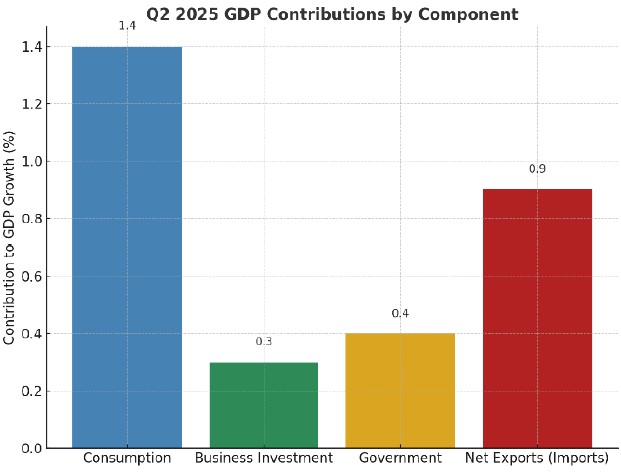
At first glance, the economy looks steady. Headline GDP grew at an annualized 3% last quarter, which would suggest strong momentum. But much like a haunted mirror, that number distorts the reflection. A one-time surge in imports, pulled forward ahead of new tariffs, inflated the reading. Strip that out and the foundation looks softer: final sales to private domestic purchasers grew just 1.2%, the weakest since 2022. Consumers are still spending, but more cautiously, and businesses remain selective with investments. Housing and autos, in particular, continue to feel the drag of higher borrowing costs.
Inflation, meanwhile, lingers like a shadow at the end of the hallway. The Fed’s preferred measure, core PCE, rose at a 3.3% annualized pace in July, with services inflation running even higher. Categories like shelter, insurance, and medical care remain stubbornly elevated, even as goods inflation eases. This puts Jerome Powell in the role of haunted house guide—keeping the group calm, knowing that the next turn might bring a harmless prop or something more jarring. Markets are convinced that rate cuts are on the horizon, but Powell has been careful not to promise relief prematurely. That tug-of-war—between a Fed trying to manage expectations and markets eager for clarity—adds to the unease.
Globally, Europe is struggling to reignite growth, with Germany’s industrial production still soft. China continues to wrestle with weak property markets and fragile consumer confidence, while trade disputes and tariffs have rattled supply chains. Yet there remain several pockets of strength internationally, offering resilience beneath the headlines. At the same time, US equities are still led by a concentrated group of mega-cap technology firms. Their strength has carried the market higher, but narrow leadership leaves little margin for error if enthusiasm fades. Even so, more than half of S&P 500 companies are trading above their long-term averages—a sign of healthier participation that extends well beyond mega-cap tech.
For Atlas portfolios, the answer isn’t to sprint for the exit but to carry the flashlight and keep moving forward. Balance remains our priority: high-quality fixed income provides ballast if growth slows, while sectors such as energy and materials offer protection against trade and supply chain disruptions. International diversification brings both valuation opportunity and currency tailwinds, and our alternatives sleeve adds flexibility. Like a haunted house with multiple exits, diversified portfolios provide us with more options if conditions change.
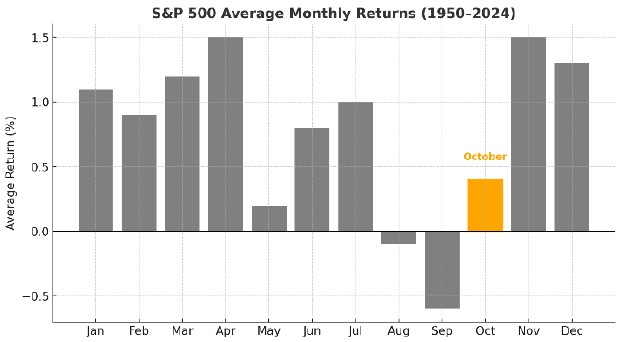
And here’s the perspective that matters: haunted houses are designed to spook us, not to collapse. Volatility in October is similar—unsettling in the moment, but rarely lasting. Markets are built to digest both fear and optimism, and history shows that while October has hosted some famous downturns, it has just as often marked the start of strong rebounds. Shadows under a strobe light look scarier than they are; when the lights return, the foundation proves sound.
Our role is to help see past the tricks. Volatility isn’t permanent loss—it’s the chance to rebalance, harvest gains, and add where valuations improve. Diversification remains the safety net, ensuring no single slip jeopardizes the broader journey. Just as haunted houses rely on fog machines and mirrors to heighten the experience, markets use headlines and uncertainty to magnify risk. But when the fog clears, what remains is a sturdier backdrop: resilient earnings, strong balance sheets, and ongoing demand.
Discipline, in this analogy, is the flashlight. It keeps us from reacting emotionally to every creak and shadow. By staying calm, invested, and flexible, we emerge not only intact but often better positioned. This October, the real task is not to eliminate fear but to recognize that most of it is staged. Inflation, tariffs, and narrow leadership are challenges, but they are not monsters waiting to pounce; instead, they are realities that require careful consideration and thoughtful management. With steady discipline, diversification, and perspective, portfolios can stay on track—even if the floorboards creak along the way.
September turned out to be one of the stronger months of the year, with the S&P 500 gaining 3.7% and now up 14.8% year-to-date. Large cap technology led the way, as the Nasdaq 100 surged 5.5% in September and is 18.1% YTD, while small caps rose 3.1% and mid-caps added 0.4%, bringing their YTD returns to 10.4% and 5.6% respectively.
International equities outpaced US markets once again. The MSCI EAFE gained 2.4% in September (25.9% YTD), and emerging markets advanced 6.9%, pushing their YTD return to 27.8%. Broad global benchmarks reflected the same trend, with ACWI up 18.7% YTD and ACWI ex-US up 26.5%.
Fixed income contributed positively as well, with Treasuries advancing 0.9% in September (5.4% YTD) and the Bloomberg US Aggregate Bond Index up 1.1% for the month and 6.1% year-to-date. Credit markets were steady, with high yield and senior loans each rising 0.6%, bringing YTD results to 7.1% and 4.9%.
Overall, September’s strength was fueled by resilient earnings, moderating inflation, and optimism that the Federal Reserve may be nearing the end of its tightening cycle.
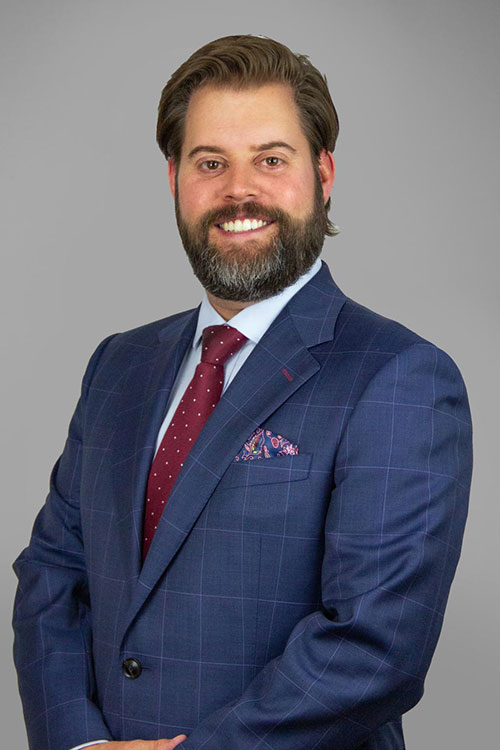
As the Chief Investment Officer, Stephen Swensen oversees investment management, research, portfolio design, and all investment-related operations at Atlas. He also chairs the Atlas Investment Committee, guiding strategic investment decisions.
Stephen’s career began as a Financial Analyst for Deseret Mutual Benefits Administration (DMBA), a role in which he managed investments for a private pension fund and insurance company. Subsequently, he served as an investment analyst and portfolio manager for local Registered Investment Advisors (RIAs). Before joining Atlas, Stephen contributed his expertise as an Outsourced Chief Investment Officer (OCIO) for the Carson Group, supporting advisors on the West Coast. Educationally, Stephen holds an MBA and an MS in Investment Management and Financial Analysis from Creighton University. He has earned the Series 65 Uniform Investment Advisor License and is actively pursuing the prestigious
Chartered Financial Analyst (CFA) designation.
Beyond his professional achievements, Stephen is an enthusiastic hockey fan, both on and off the ice. He finds joy in playing the piano, golfing, reading, and outdoor cooking. However, his greatest source of happiness comes from spending quality time with his wife and four children
NOTICE REGARDING INVESTMENT DISCLOSURES: The contents of this memo reflect the opinions of the author(s) as of the indicated date and are subject to change without notice. Atlas Investment Management has no obligation to update the information provided here. It should not be assumed that past investment performance guarantees future results. Potential for profit also entails the risk of loss.
The information presented is believed to be current and is not personalized investment advice. All opinions expressed are as of the date of the presentation and may change over time. All investment strategies carry the potential for profit or loss. Asset allocation and diversification cannot guarantee improved returns or eliminate the risk of investment losses. Target allocations may deviate due to market conditions and other factors. There is no guarantee that any investment or strategy will be suitable or profitable for an investor’s portfolio. Different types of investments involve varying levels of risk.
The charts and slides do not depict the performance of Atlas Investment Management or any of its advisory clients. Historical performance returns for investment indexes and/or categories typically do not factor in transaction and/or custodial charges or an advisory fee, which may decrease historical performance results. There is no assurance that an investor’s portfolio will match or exceed a specific benchmark.
This communication, including any attachments, is intended exclusively for the addressee and may contain proprietary, confidential, or privileged information. Unauthorized use, copying, disclosure, dissemination, or distribution is strictly prohibited. If you are not the intended recipient, please immediately notify the sender by return email, delete this communication, and destroy all copies.
Securities are offered through Purshe Kaplan Sterling Investments, Member FINRA/SIPC, headquartered at 80 State Street, Albany, NY 12207. Investment Advisory services are offered through Ignite Planners, LLC. Purshe Kaplan Sterling Investments and Ignite Planners, LLC are not affiliated companies. Ignite Planners, LLC conducts business only in states where it is properly registered or is excluded or exempted from registration requirements. SEC registration does not constitute an endorsement of the firm by the Commission and does not imply that the advisor has achieved a particular level of skill or ability. All investment strategies carry the potential for profit or loss.