
“Whenever you find yourself on the side of the majority, it is time to pause
and reflect.”
–Mark Twain (1835–1910), American Author, Essayist, and Humorist
Volume 36
Perspective at the Trailhead
What Happened in the Markets
Subscribe and start receiving the Atlas Memo directly to your email

January always feels a bit like standing at the trailhead of a long hike.
You haven’t taken your first step yet, but you’re not showing up cold either. You glance back at the path behind you, adjust your pack, check the weather, and remind yourself that the goal isn’t to sprint—it’s to make smart, steady progress without tripping over the first rock.
That’s exactly how we think about entering 2026.
In other words, the air may get choppy at times, but the tailwind is real.
Before we talk about where markets may go next, it’s worth pausing to acknowledge 2025 for what it was—a year that rewarded discipline, patience, and perspective. Global equities posted strong gains, bonds delivered their best year in several cycles, and diversification mattered more than many expected. It wasn’t a smooth walk, but it was a productive one for investors who stayed on the trail.
More importantly, 2025 reinforced several timeless lessons that are highly relevant as we look ahead.
Markets have a long history of humbling consensus. When an outcome feels obvious— whether optimistic or pessimistic—it’s often already reflected in prices. Early in 2025, confidence around US market dominance was widespread, while skepticism toward international markets and a stronger dollar was nearly universal. What followed was a reminder that opportunity often lives where expectations are lowest, not highest.
Diversification wasn’t just helpful last year—it was additive. Investors who remained open to opportunities outside the most crowded narratives were rewarded, reinforcing the idea that flexibility beats certainty over full market cycles.
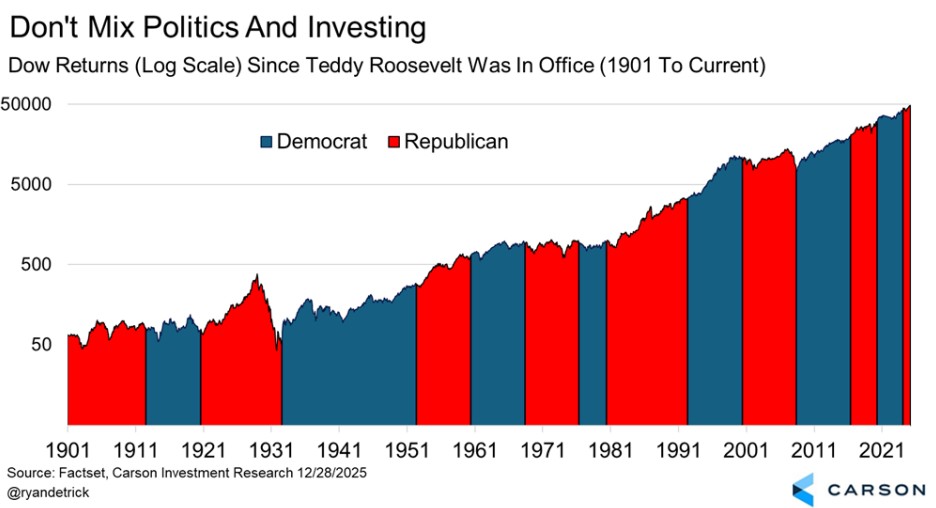
Another lesson 2025 reinforced is that markets don’t respond to political preferences— they respond to fundamentals. Earnings, liquidity, inflation trends, and overall economic momentum matter far more than who dominates the headlines. When investors allow political views or discomfort to drive portfolio decisions, the outcome is often suboptimal.
History continues to show that letting politics influence investment behavior frequently leads to missed opportunities. Last year was no exception. Investors who stayed anchored to a disciplined process—rather than reacting emotionally to the news cycle—were better positioned to participate in the market’s recovery and strength.
This chart from my friends at Carson Wealth is a useful reminder of that reality. While there are modest historical differences depending on how Washington is structured, markets ultimately care far more about economic growth, Federal Reserve policy, inflation dynamics, and corporate earnings than party affiliation. When those fundamentals are in place, markets have demonstrated an ability to perform across a wide range of political
environments.
Even the most experienced strategists are reacting to markets as much as forecasting them. Targets get raised, lowered, and revised—often after markets have already moved. The real edge doesn’t come from perfect predictions; it comes from building portfolios designed to adapt when reality inevitably diverges from expectations.
Humility is an underrated investment advantage.
So, What Does This Mean for 2026? As we enter the new year, our outlook is constructive—but grounded. Economic growth remains resilient, inflation pressures have moderated meaningfully from prior peaks, and corporate fundamentals continue to hold up better than many feared. That said, markets rarely move in straight lines. Volatility will resurface. Headlines will feel urgent. There will be moments that test conviction.
That’s not a flaw of the market—that’s the price of admission.
At Atlas, our focus remains on maintaining disciplined, diversified portfolios aligned with long-term objectives rather than short-term narratives. We’re not trying to predict every twist in the trail ahead. We’re focused on solid footing—risk management, thoughtful rebalancing, and evidence-based decision-making.
Which brings us back to the trailhead.
Successful hikes aren’t defined by perfect weather or flawless maps. They’re defined by preparation, pacing, and the ability to keep moving when conditions change. 2025 reminded us that patience still pays, discipline still matters, and staying invested through uncertainty remains one of the most reliable advantages an investor can have.
We enter 2026 with respect for the path behind us, confidence in our process, and a steady eye on the trail ahead. As always, thank you for your trust.
December was a relatively subdued month, with most major US equity indexes finishing essentially flat. The S&P 500 edged up 0.06%, while small caps declined modestly, with the Russell 2000 down 0.58%. Midcap stocks were little changed, and the tech-heavy Nasdaq 100 slipped 0.67% as leadership cooled into year-end. In contrast, international equities finished strong, with developed markets gaining 2.68% and emerging markets up 2.56%.
Looking at the full year, 2025 delivered solid returns across a broad range of asset classes. The S&P 500 returned 17.88%, while the Nasdaq 100 led US equities with a 21.02% gain. Small caps and mid caps posted positive— but more muted—returns of 12.81% and 7.20%. Outside the US, performance was especially strong, with developed international stocks up 31.38%, emerging markets surging 33.34%, and global equities returning more than 22%.
Fixed income also contributed meaningfully in 2025, providing
diversification alongside equity gains. US Treasuries returned 6.15%, core bonds gained 7.19%, and credit markets remained constructive. High yield bonds rose 8.56%, while senior loans returned 6.66%. In short, December capped off a year defined by broad participation across equities and fixed income—one that rewarded diversification and staying invested through market noise.
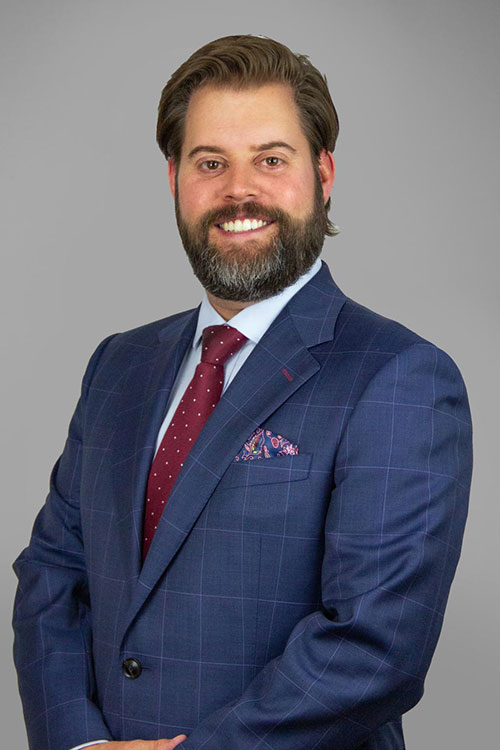
As the Chief Investment Officer, Stephen Swensen oversees investment management, research, portfolio design, and all investment-related operations at Atlas. He also chairs the Atlas Investment Committee, guiding strategic investment decisions.
Stephen’s career began as a Financial Analyst for Deseret Mutual Benefits Administration (DMBA), a role in which he managed investments for a private pension fund and insurance company. Subsequently, he served as an investment analyst and portfolio manager for local Registered Investment Advisors (RIAs). Before joining Atlas, Stephen contributed his expertise as an Outsourced Chief Investment Officer (OCIO) for the Carson Group, supporting advisors on the West Coast. Educationally, Stephen holds an MBA and an MS in Investment Management and Financial Analysis from Creighton University. He has earned the Series 65 Uniform Investment Advisor License and is actively pursuing the prestigious
Chartered Financial Analyst (CFA) designation.
Beyond his professional achievements, Stephen is an enthusiastic hockey fan, both on and off the ice. He finds joy in playing the piano, golfing, reading, and outdoor cooking. However, his greatest source of happiness comes from spending quality time with his wife and four children
NOTICE REGARDING INVESTMENT DISCLOSURES: The contents of this memo reflect the opinions of the author(s) as of the indicated date and are subject to change without notice. Atlas Investment Management has no obligation to update the information provided here. It should not be assumed that past investment performance guarantees future results. Potential for profit also entails the risk of loss.
The information presented is believed to be current and is not personalized investment advice. All opinions expressed are as of the date of the presentation and may change over time. All investment strategies carry the potential for profit or loss. Asset allocation and diversification cannot guarantee improved returns or eliminate the risk of investment losses. Target allocations may deviate due to market conditions and other factors. There is no guarantee that any investment or strategy will be suitable or profitable for an investor’s portfolio. Different types of investments involve varying levels of risk.
The charts and slides do not depict the performance of Atlas Investment Management or any of its advisory clients. Historical performance returns for investment indexes and/or categories typically do not factor in transaction and/or custodial charges or an advisory fee, which may decrease historical performance results. There is no assurance that an investor’s portfolio will match or exceed a specific benchmark.
This communication, including any attachments, is intended exclusively for the addressee and may contain proprietary, confidential, or privileged information. Unauthorized use, copying, disclosure, dissemination, or distribution is strictly prohibited. If you are not the intended recipient, please immediately notify the sender by return email, delete this communication, and destroy all copies.
Securities are offered through Purshe Kaplan Sterling Investments, Member FINRA/SIPC, headquartered at 80 State Street, Albany, NY 12207. Investment Advisory services are offered through Ignite Planners, LLC. Purshe Kaplan Sterling Investments and Ignite Planners, LLC are not affiliated companies. Ignite Planners, LLC conducts business only in states where it is properly registered or is excluded or exempted from registration requirements. SEC registration does not constitute an endorsement of the firm by the Commission and does not imply that the advisor has achieved a particular level of skill or ability. All investment strategies carry the potential for profit or loss.