
“Smooth seas do not make skillful sailors.”
–African Proverb
Volume 39
Navigating the Storm: What’s Changed and What Hasn’t
What Happened in the Markets
Subscribe and start receiving the Atlas Memo directly to your email

Driving through the mountains, storms can roll in quickly. One minute the skies are clear, and the next you’re dealing with heavy rain, reduced visibility, and a road that suddenly demands more attention. The destination hasn’t changed, and the road itself hasn’t changed—but how you navigate it does.
That’s a useful way to think about markets right now.
Over the past several weeks, the investment landscape has become more complex, not because the underlying economy has broken, but because an external force has entered the system. The escalation of conflict in the Middle East and the resulting surge in oil prices have introduced a meaningful energy shock into the global economy.
What was previously a background risk has now become a primary driver.
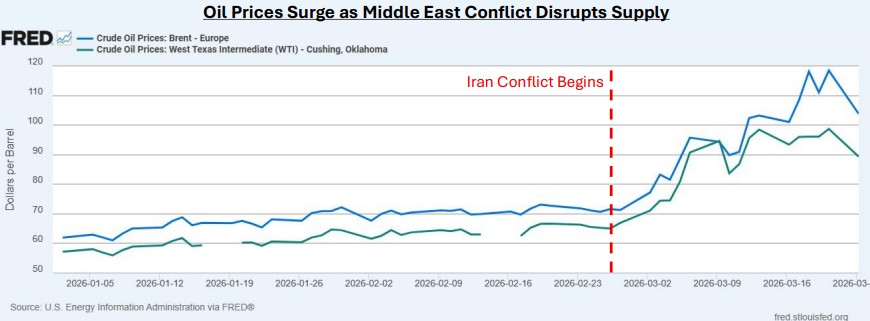
Oil prices have moved sharply higher, driven by disruptions tied to the Strait of Hormuz, one of the most important energy transit points in the world. This isn’t just a price move; it’s a constraint on supply. And when energy supply tightens this quickly, it tends to ripple through the broader economy. Businesses face higher input costs, consumers feel pressure at the pump and in everyday goods, and early signs of slower demand are emerging.
We are already starting to see those effects take shape.
At the same time, the Federal Reserve has subtly shifted its posture. At the beginning of the year, the expectation was that moderating inflation and a gradually softening labor market would allow for a measured path toward rate cuts. That path has become less clear.
Today, the Fed is navigating between two competing risks. On one side, higher energy prices and lingering tariff effects create the potential for inflation to remain elevated. On the other hand, the labor market—while still stable—is showing signs of slowing. In this environment, policymakers have moved into a more patient, “wait-and-see” stance, with a higher bar for near-term rate cuts.
In short, the Fed is no longer operating with a clear easing bias; it is operating with flexibility.
What makes the current environment particularly interesting is how markets are responding. While the Fed has grown more cautious, the bond market has begun to lean in a different direction. Treasury yields have declined, reflecting a growing view that the second-order effects of higher energy prices may ultimately matter more than the initial inflation impulse.
Not simply “oil equals inflation,” but “oil equals pressure on growth.”
That distinction is important. Higher energy costs act as a drag on economic activity over time. They reduce discretionary spending, compress margins, and can slow hiring if sustained. Markets are increasingly recognizing that dynamic, which is why fixed income has begun to reassert itself as a stabilizing component within portfolios.
This leaves us in a more nuanced environment—one where both inflation and growth risks are present, but not necessarily on the same timeline. We are not in a stagflationary environment, but we are closer to the conditions that could create one if current trends persist.
For investors, this kind of environment can feel unsettling. Markets may move quickly, narratives can shift from day to day, and headlines often amplify the uncertainty. But it’s important to keep a few key principles in mind.
First, volatility is not the same as deterioration. Markets are adjusting to a wider range of potential outcomes, and that adjustment process is rarely smooth. Periods like this are normal, even within otherwise constructive market environments.
Second, the Federal Reserve is unlikely to act as an immediate backstop. The bar for rate cuts has risen in the near term, particularly if inflation expectations begin to drift higher. Policy will respond, but deliberately.
Third, and most importantly, the long-term drivers of returns remain intact. Earnings growth, productivity gains, and continued capital investment are still present beneath the surface.
These are the factors that ultimately shape outcomes over time, even when the macro backdrop becomes more complicated.

Which brings us back to the mountain storm. When conditions change, experienced drivers don’t panic—they adjust. They slow down, focus, and stay committed to the road ahead. The goal isn’t to avoid the storm entirely, but to navigate through it with discipline.
Markets today are in a similar phase. The environment has shifted, and the path forward may feel less predictable in the short term. But the underlying structure remains in place, and the long-term destination hasn’t changed.
As always, our approach remains consistent: stay disciplined, stay diversified, and focus on the fundamentals that drive long-term success. Because while storms can change how the journey feels in the moment, they rarely change where the road ultimately leads.
March saw broad-based declines across risk assets as rising energy prices and geopolitical uncertainty drove a sharp repricing of macro expectations. The S&P 500 fell 5.0% and the Nasdaq 100 declined 4.8%, with small- and mid-cap stocks also pulling back (Russell 2000 -5.0%, S&P 400 -5.4%).
International markets were weaker, with MSCI EAFE down 8.2% and emerging markets falling 10.0%. Global indices reflected this pressure, as MSCI ACWI declined 6.3% and ACWI ex-US dropped 10.3%, highlighting the global nature of the selloff.
Fixed income declined modestly, with US Treasuries and core bonds both down 1.7%. Credit was mixed, with high yield bonds falling 1.0% while senior loans gained 1.1%.
Despite the challenging month, first-quarter results were more balanced. The S&P 500 declined 4.3% and the Nasdaq 100 fell 5.8%, but mid caps (+2.4%), small caps (+0.89%), and emerging markets (+2.8%) posted gains, reflecting broader participation beneath the surface.
In short, March reflects a rapid repricing of uncertainty, while first-quarter results reinforce the value of diversification and staying invested through changing conditions.
As the Chief Investment Officer, Stephen Swensen oversees investment management, research, portfolio design, and all investment-related operations at Atlas. He also chairs the Atlas Investment Committee, guiding strategic investment decisions.
Stephen’s career began as a Financial Analyst for Deseret Mutual Benefits Administration (DMBA), a role in which he managed investments for a private pension fund and insurance company. Subsequently, he served as an investment analyst and portfolio manager for local Registered Investment Advisors (RIAs). Before joining Atlas, Stephen contributed his expertise as an Outsourced Chief Investment Officer (OCIO) for the Carson Group, supporting advisors on the West Coast. Educationally, Stephen holds an MBA and an MS in Investment Management and Financial Analysis from Creighton University. He has earned the Series 65 Uniform Investment Advisor License and is actively pursuing the prestigious
Chartered Financial Analyst (CFA) designation.
Beyond his professional achievements, Stephen is an enthusiastic hockey fan, both on and off the ice. He finds joy in playing the piano, golfing, reading, and outdoor cooking. However, his greatest source of happiness comes from spending quality time with his wife and four children

NOTICE REGARDING INVESTMENT DISCLOSURES: The contents of this memo reflect the opinions of the author(s) as of the indicated date and are subject to change without notice. Atlas Investment Management has no obligation to update the information provided here. It should not be assumed that past investment performance guarantees future results. Potential for profit also entails the risk of loss.
The information presented is believed to be current and is not personalized investment advice. All opinions expressed are as of the date of the presentation and may change over time. All investment strategies carry the potential for profit or loss. Asset allocation and diversification cannot guarantee improved returns or eliminate the risk of investment losses. Target allocations may deviate due to market conditions and other factors. There is no guarantee that any investment or strategy will be suitable or profitable for an investor’s portfolio. Different types of investments involve varying levels of risk.
The charts and slides do not depict the performance of Atlas Investment Management or any of its advisory clients. Historical performance returns for investment indexes and/or categories typically do not factor in transaction and/or custodial charges or an advisory fee, which may decrease historical performance results. There is no assurance that an investor’s portfolio will match or exceed a specific benchmark.
This communication, including any attachments, is intended exclusively for the addressee and may contain proprietary, confidential, or privileged information. Unauthorized use, copying, disclosure, dissemination, or distribution is strictly prohibited. If you are not the intended recipient, please immediately notify the sender by return email, delete this communication, and destroy all copies.
Securities are offered through Purshe Kaplan Sterling Investments, Member FINRA/SIPC, headquartered at 80 State Street, Albany, NY 12207. Investment Advisory services are offered through Ignite Planners, LLC. Purshe Kaplan Sterling Investments and Ignite Planners, LLC are not affiliated companies. Ignite Planners, LLC conducts business only in states where it is properly registered or is excluded or exempted from registration requirements. SEC registration does not constitute an endorsement of the firm by the Commission and does not imply that the advisor has achieved a particular level of skill or ability. All investment strategies carry the potential for profit or loss.