
“There is no better teacher than history in determining the future…there are answers worth billions of dollars in a thirty-dollar history book.”
–Charlie Munger (1924–2023), Vice Chairman of Berkshire Hathaway
Volume 40
The Market Playbook: Don’t Leave the Game Early
What Happened in the Markets
Subscribe and start receiving the Atlas Memo directly to your email

If you’ve read these memos for a while, you know I have a bit of a soft spot for hockey. With the Stanley Cup Playoffs just getting underway, it’s that time of year where every game feels a little bigger, a little faster, and a lot more unpredictable—so naturally, it’s been on my mind.
And if you’ve ever watched a playoff game, you know there’s always that moment late in the second period when things feel…uncertain. One team might be down a goal, momentum looks shaky, and a few fans start heading for the exits to beat traffic. It feels like the outcome is already decided.
Then the third period starts—and everything changes.
Momentum flips. The pace accelerates. And the people who left early realize they missed the best part of the game. Markets have a funny way of doing the same thing.
Coming into this year, the market gave us a version of that second period. We had volatility, a sharp drawdown in March, and a steady stream of headlines that made it feel like things were breaking down. From a distance, it was easy to question whether the bull market that has been in place for the past several years had finally run its course.
But as we closed out April, the picture looks very different.
Markets have rebounded meaningfully, and importantly, this recovery hasn’t been driven solely by speculation or optimism. Under the surface, corporate earnings expectations have continued to rise, even amid periods of geopolitical stress and elevated uncertainty. In fact, the primary driver of market gains this year has been improving profit expectations, not investors simply paying more for the same earnings.
That distinction matters. It tells us that the market’s foundation remains intact.
To help bring this to life, we built the chart below. What this shows is the “typical” path of a market year, along with the normal range of outcomes, and overlays it with what we’ve experienced so far in 2026. A few things stand out immediately.
First, the March drawdown, which was uncomfortable, actually falls within the normal range of outcomes. It felt significant in the moment, but historically, it wasn’t unusual.
Second, the rebound in April didn’t just recover losses; it pushed us back above the average path for the year. In other words, what felt like a fragile environment just weeks ago has returned to a position of relative strength from a market standpoint.
And third, where we sit today is a zone that has historically supported continued upside into the middle part of the year.
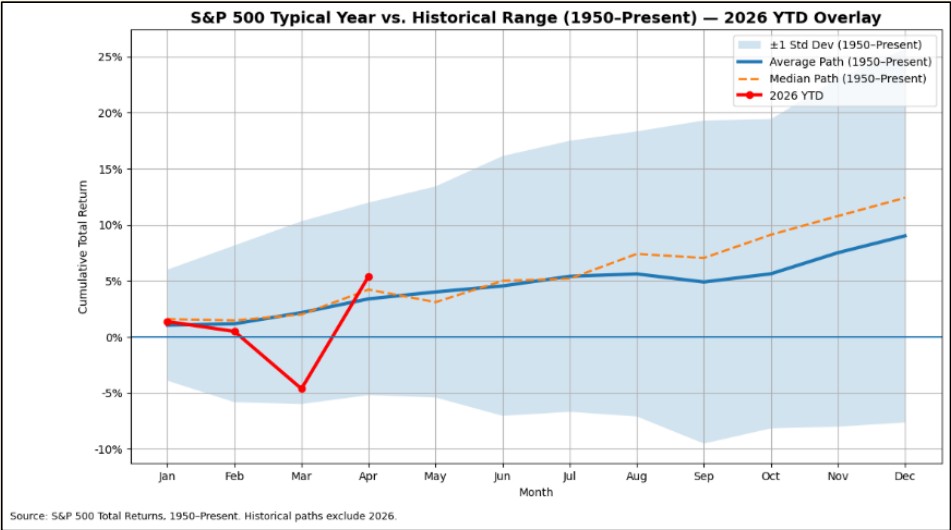
This is an important reminder: volatility is not a signal that something is broken. More often, it’s simply part of how markets move forward.
As we turn the calendar to May, another familiar narrative begins to
circulate: “Sell in May and go away.”
It’s one of those phrases that sounds convincing because it’s simple. Historically, the May through October period has been the weakest six months of the year, with average returns of about 2%. But context matters.
Even during this “weaker” period, markets are still positive the majority of the time. More recently, that seasonal pattern has been even less reliable, with stocks rising in nine of the past ten years during this window.
And importantly, when markets enter this period with positive momentum, as they have this year, forward returns have historically been stronger, not weaker. So while the phrase gets attention, it’s not a reason we view as grounds to step away from the market.
What we’re seeing today is far more consistent with a market that went through a period of stress, reset expectations, and is now continuing its longer-term trend.
Some of the strengths we’ve seen recently have actually been historically significant. Rapid rallies like the one we experienced off the March lows have often been associated with durable bottoms and higher prices over time, not the beginning of a new downturn. At the same time, participation across the market has improved, another sign of a healthier, more sustainable move.
Stepping back further, this bull market is now more than three years old and has nearly doubled from its lows. Historically, when markets reach this stage, they tend to continue for several more years rather than ending abruptly. That doesn’t mean the path forward will be smooth. It rarely is. But the broader trend remains constructive.
So where does that leave us? We remain focused on what actually drives long-term outcomes: earnings growth, economic resilience, and market structure. Right now, those factors remain supportive. At the same time, we remain disciplined in how we position portfolios, knowing that short-term swings are simply part of the process. Seasonal narratives will come and go. Headlines will shift. But the underlying drivers of markets tend to move more steadily than the day-to-day noise might suggest.
Coming back to our hockey analogy, this is the part of the game where patience matters most. The second period didn’t look great. There were moments when momentum felt like it was slipping away. But the game wasn’t over—it was just transitioning. And now, as we move into the next stretch of the year, the setup looks much more like the start of a third period than the end of a game. The investors who tend to do well over time aren’t the ones who try to leave early and perfectly time every move. They’re the ones who understand the flow, stay disciplined, and remain in position when momentum turns. Because often, the best part of the game comes after it feels the most uncertain.
As always, we appreciate the trust you place in us and remain focused on navigating these markets thoughtfully and with discipline.
April was a strong “risk-on” month, with equities rebounding sharply after a choppy start to the year. The S&P 500 gained +10.5%, while the Nasdaq 100 led with a +15.7% surge, driven by strength in growth and technology. Market breadth improved as well, with the Russell 2000 (+12.2%) and S&P 400 (+7.8%) also posting solid gains.
International markets participated, though slightly lagged the US. MSCI EAFE rose +5.8%, while emerging markets stood out at +12.9%. Broad global equities (MSCI ACWI) advanced +9.6%, signaling a coordinated global move higher.
Fixed income was more muted. Core bonds were essentially flat, with the US Aggregate Bond Index up +0.1% and Treasuries slightly negative at -0.1%. In contrast, credit-sensitive areas like high yield (+1.6%) and senior loans (+1.1%) benefited from improving risk appetite.
April saw a sharp return to risk assets, led by equities and confirmed by credit markets. The rapid rebound shows investors quickly adjusted and favored risk. Such moves reward disciplined strategies
over reactive choices.
As the Chief Investment Officer, Stephen Swensen oversees investment management, research, portfolio design, and all investment-related operations at Atlas. He also chairs the Atlas Investment Committee, guiding strategic investment decisions.
Stephen’s career began as a Financial Analyst for Deseret Mutual Benefits Administration (DMBA), a role in which he managed investments for a private pension fund and insurance company. Subsequently, he served as an investment analyst and portfolio manager for local Registered Investment Advisors (RIAs). Before joining Atlas, Stephen contributed his expertise as an Outsourced Chief Investment Officer (OCIO) for the Carson Group, supporting advisors on the West Coast. Educationally, Stephen holds an MBA and an MS in Investment Management and Financial Analysis from Creighton University. He has earned the Series 65 Uniform Investment Advisor License and is actively pursuing the prestigious
Chartered Financial Analyst (CFA) designation.
Beyond his professional achievements, Stephen is an enthusiastic hockey fan, both on and off the ice. He finds joy in playing the piano, golfing, reading, and outdoor cooking. However, his greatest source of happiness comes from spending quality time with his wife and four children

NOTICE REGARDING INVESTMENT DISCLOSURES: The contents of this memo reflect the opinions of the author(s) as of the indicated date and are subject to change without notice. Atlas Investment Management has no obligation to update the information provided here. It should not be assumed that past investment performance guarantees future results. Potential for profit also entails the risk of loss.
The information presented is believed to be current and is not personalized investment advice. All opinions expressed are as of the date of the presentation and may change over time. All investment strategies carry the potential for profit or loss. Asset allocation and diversification cannot guarantee improved returns or eliminate the risk of investment losses. Target allocations may deviate due to market conditions and other factors. There is no guarantee that any investment or strategy will be suitable or profitable for an investor’s portfolio. Different types of investments involve varying levels of risk.
The charts and slides do not depict the performance of Atlas Investment Management or any of its advisory clients. Historical performance returns for investment indexes and/or categories typically do not factor in transaction and/or custodial charges or an advisory fee, which may decrease historical performance results. There is no assurance that an investor’s portfolio will match or exceed a specific benchmark.
This communication, including any attachments, is intended exclusively for the addressee and may contain proprietary, confidential, or privileged information. Unauthorized use, copying, disclosure, dissemination, or distribution is strictly prohibited. If you are not the intended recipient, please immediately notify the sender by return email, delete this communication, and destroy all copies.
Securities are offered through Purshe Kaplan Sterling Investments, Member FINRA/SIPC, headquartered at 80 State Street, Albany, NY 12207. Investment Advisory services are offered through Ignite Planners, LLC. Purshe Kaplan Sterling Investments and Ignite Planners, LLC are not affiliated companies. Ignite Planners, LLC conducts business only in states where it is properly registered or is excluded or exempted from registration requirements. SEC registration does not constitute an endorsement of the firm by the Commission and does not imply that the advisor has achieved a particular level of skill or ability. All investment strategies carry the potential for profit or loss.