
“Plans are worthless, but planning is everything.”
–Dwight D. Eisenhower, 34th President of the United States
Volume 41
Reading the Gauges: Resilience, Rates, and a More Selective Market
What Happened in the Markets
Subscribe and start receiving the Atlas Memo directly to your email

Most of us have had the experience of driving down the road and glancing at the dashboard. The car may be running smoothly, the road may be clear, and everything may feel perfectly normal. But a good driver still keeps an eye on the gauges. Speed matters. Fuel matters. Engine temperature matters. None of those gauges by itself tells the whole story, but together they help us understand the drive.
That is a useful way to think about markets today. From the outside, the economy still looks remarkably resilient. Stocks have continued to move higher, corporate earnings have held up, and consumers are still spending. In fact, nominal consumer spending has been strong, rising at an annualized pace of roughly 9% over the past three months and nearly 6% from a year ago. That kind of
spending helps explain why corporate revenue and profit trends have remained better than many investors expected.
But like any dashboard, the details matter.
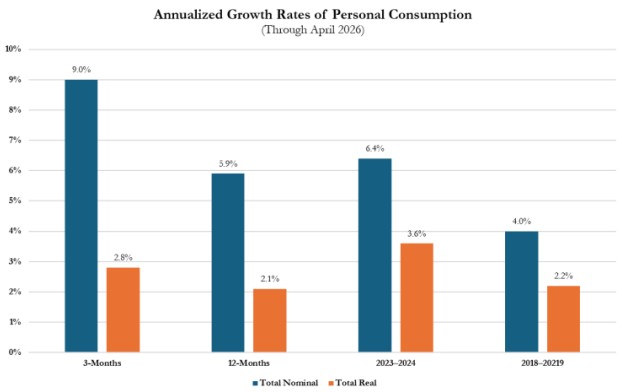
The first gauge worth watching is inflation. A meaningful portion of the recent spending strength is not simply consumers buying more goods and services; it is consumers paying higher prices for many of the same goods and services. Gasoline and fuel spending, for example, has surged in dollar terms, but after adjusting for inflation, consumers are actually buying fewer gallons. Grocery spending tells a similar story: households are spending more, but the real volume of what they are buying has not increased much.
That does not mean the consumer is broken. It means the consumer is navigating a more expensive environment. Real spending growth remains positive, but it has slowed from the stronger pace we saw in 2023 and 2024. At the same time, real income growth has softened. Income is still growing in nominal terms, but inflation is taking a larger bite. Real personal income excluding government transfers has declined over the past year, and the personal savings rate has fallen from 5.5% a year ago to 2.6% today.
In plain English, consumers are still driving, but the economic fuel is not quite what it used to be.
The second gauge is the bond market. Treasury yields have moved sharply higher over the past several months. Since late February, the 2-year Treasury yield has risen from 3.39% to 4.05%, while the 10-year Treasury yield has climbed from 3.95% to 4.48%. The 30-year Treasury yield has also moved to roughly 5%, reaching levels not seen in decades.
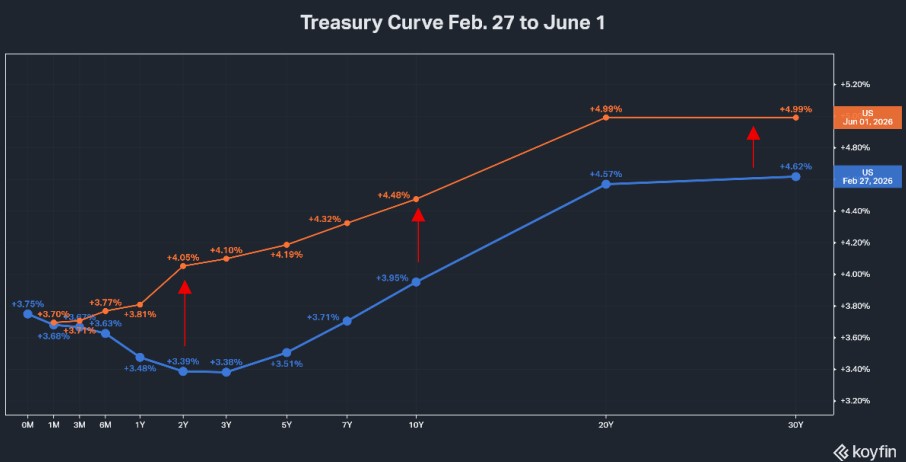
That matters because the bond market is often where inflation concerns show up most directly. Higher inflation typically leads investors to demand higher yields, especially when there is uncertainty about whether the Federal Reserve will need to keep rates higher for longer. In the current environment, the market is increasingly questioning whether the Fed may need to stay more restrictive than previously expected.
There are also supply and demand issues at work. The US continues to run large fiscal deficits, which means Treasury supply remains high. At the same time, foreign bond markets are becoming more competitive. Japan is a notable example. After years of near-zero or negative yields, Japanese government bond yields have risen substantially, making US Treasuries slightly less compelling on a relative basis for some global buyers.
That does not mean Treasuries are unattractive. It means the fixed income environment has become more nuanced. The old playbook—where global investors had almost no alternative to US bonds—is not as simple as it once was.
The third gauge is energy. Oil prices have risen sharply due to the ongoing Middle East conflict and continued pressure around the Strait of Hormuz. Higher energy prices can be inflationary, but they can also become a drag on growth if sustained. They raise costs for businesses, reduce household flexibility, and make the Fed’s job more complicated.
This is the difficult balance in the current environment: inflationary pressure can keep rates elevated, while higher prices can eventually slow economic activity. That combination does not automatically mean recession, but it does require more precision from investors. The road is still open, but visibility is not quite as clear as it was during the easier stretch of the cycle.
Then there is the fourth gauge: valuations. With stocks near all-time highs, it is reasonable for investors to ask whether markets are getting too expensive. The answer is not as simple as “yes” or “no”. Valuations are not uniform across the market. Some areas may be stretched, while others are more reasonable. Even within technology and AI-related companies, the story is more nuanced than the headlines suggest.
One interesting example is the semiconductor space. Traditional semiconductor companies have traded at much higher earnings multiples, while certain memory-related companies, despite strong recent price moves, have seen earnings expectations rise even faster than stock prices. In some cases, valuations have actually fallen as profits have been revised higher.
That is why we continue to emphasize relative valuations rather than broad labels like “bubble”. Are there areas of the market that deserve caution? Yes. Are there also areas where earnings growth, productivity, and long-term capital investment still support the case for ownership? Also, yes.
Markets rarely move as one clean, tidy unit. They rotate, reprice, and occasionally behave like a toddler who found the thermostat. That is why diversification and disciplined portfolio construction remain so important.
So where does that leave us? The economy shows resilience, with supportive consumer spending, stable corporate earnings, and long-term drivers such as productivity, tech investment, and AI infrastructure. However, higher yields, persistent inflation, and tighter household cash flows mean selectivity is more crucial than it was when money was cheap—and most assets thrived.
This is not a moment for panic. It is a moment for awareness. At Atlas, our focus remains on building portfolios that can adapt across environments. That means maintaining exposure to long-term growth, staying thoughtful about fixed income positioning, using diversification intentionally, and avoiding the temptation to chase every headline or abandon a plan because one gauge moved.
Which brings us back to the dashboard. A good driver does not stare at one gauge and forget the road. They monitor speed, fuel, temperature, traffic, and weather together. Markets require the same kind of awareness. Inflation, interest rates, consumer spending, valuations, and earnings all matter, but none of them should be viewed in isolation.

Today’s market is not flashing a “pull over immediately” signal. It is asking investors to drive with both hands on the wheel. The economy remains resilient, corporate earnings are still supportive, and long-term themes such as productivity, technology investment, and innovation continue to matter. At the same time, higher yields and stickier inflation mean portfolio discipline is more important than ever.
At Atlas, that is exactly the kind of environment where process becomes valuable. We remain focused on diversified portfolios, thoughtful rebalancing, and staying aligned with long-term goals rather than reacting to every short-term market vibration. The road may be less smooth than it was earlier in the cycle, but the destination has not changed.
As always, thank you for the trust you place in us.
May was another strong month for risk assets, with equities continuing April’s rebound. The S&P 500 gained 5.26%, while the Nasdaq 100 led major US indexes with a 10.58% return, reflecting
strength in growth, technology, and AI-related leadership. Small caps also participated, with the Russell 2000 up 4.37%, while mid-cap stocks rose 2.42%.
International equities were positive as well, though leadership remained tilted toward the US. Developed international markets gained 2.40%, while emerging markets rose 7.90%. Broad global equities advanced 4.80%, and ACWI ex-US gained 4.85%, showing the rally extended beyond US markets.
Fixed income was more subdued as rising yields weighed on rate-sensitive bonds. Core bonds were nearly flat, with the US Aggregate Bond Index down 0.08%, while Treasuries gained 0.12%. Credit-sensitive areas performed better, with senior loans up 1.05% and
high yield bonds gaining 1.59%.
Overall, May boosted the market’s risk-on tone. Equity strength was broad, led by growth and tech. Fixed income was mixed, with credit
outperforming bonds. Markets advanced, but leadership stayed selective, linked to earnings, growth outlook, and disciplined strategy.
As the Chief Investment Officer, Stephen Swensen oversees investment management, research, portfolio design, and all investment-related operations at Atlas. He also chairs the Atlas Investment Committee, guiding strategic investment decisions.
Stephen’s career began as a Financial Analyst for Deseret Mutual Benefits Administration (DMBA), a role in which he managed investments for a private pension fund and insurance company. Subsequently, he served as an investment analyst and portfolio manager for local Registered Investment Advisors (RIAs). Before joining Atlas, Stephen contributed his expertise as an Outsourced Chief Investment Officer (OCIO) for the Carson Group, supporting advisors on the West Coast. Educationally, Stephen holds an MBA and an MS in Investment Management and Financial Analysis from Creighton University. He has earned the Series 65 Uniform Investment Advisor License and is actively pursuing the prestigious
Chartered Financial Analyst (CFA) designation.
Beyond his professional achievements, Stephen is an enthusiastic hockey fan, both on and off the ice. He finds joy in playing the piano, golfing, reading, and outdoor cooking. However, his greatest source of happiness comes from spending quality time with his wife and four children

NOTICE REGARDING INVESTMENT DISCLOSURES: The contents of this memo reflect the opinions of the author(s) as of the indicated date and are subject to change without notice. Atlas Investment Management has no obligation to update the information provided here. It should not be assumed that past investment performance guarantees future results. Potential for profit also entails the risk of loss.
The information presented is believed to be current and is not personalized investment advice. All opinions expressed are as of the date of the presentation and may change over time. All investment strategies carry the potential for profit or loss. Asset allocation and diversification cannot guarantee improved returns or eliminate the risk of investment losses. Target allocations may deviate due to market conditions and other factors. There is no guarantee that any investment or strategy will be suitable or profitable for an investor’s portfolio. Different types of investments involve varying levels of risk.
The charts and slides do not depict the performance of Atlas Investment Management or any of its advisory clients. Historical performance returns for investment indexes and/or categories typically do not factor in transaction and/or custodial charges or an advisory fee, which may decrease historical performance results. There is no assurance that an investor’s portfolio will match or exceed a specific benchmark.
This communication, including any attachments, is intended exclusively for the addressee and may contain proprietary, confidential, or privileged information. Unauthorized use, copying, disclosure, dissemination, or distribution is strictly prohibited. If you are not the intended recipient, please immediately notify the sender by return email, delete this communication, and destroy all copies.
Securities are offered through Purshe Kaplan Sterling Investments, Member FINRA/SIPC, headquartered at 80 State Street, Albany, NY 12207. Investment Advisory services are offered through Ignite Planners, LLC. Purshe Kaplan Sterling Investments and Ignite Planners, LLC are not affiliated companies. Ignite Planners, LLC conducts business only in states where it is properly registered or is excluded or exempted from registration requirements. SEC registration does not constitute an endorsement of the firm by the Commission and does not imply that the advisor has achieved a particular level of skill or ability. All investment strategies carry the potential for profit or loss.