
“You can’t stop the waves, but you can learn to surf.”
–Jon Kabat-Zinn, Emeritus Professor, Author, and Mindfulness Teacher
Volume 42
Mind the Undertow: The Current Beneath a Calm Market
What Happened in the Markets
Subscribe and start receiving the Atlas Memo directly to your email

Anyone who spends time at the ocean learns to respect what they cannot see. From the sand, the water looks inviting: sun on the surface, gentle swells, everyone wading in. But the real story runs underneath. A rip current does not announce itself, and swimmers who get caught often make the same mistake, fighting straight back against the pull until they are exhausted. The ones who make it home stay calm and swim parallel to shore until they are free of it.
Markets have that same quality right now. The surface looks warm, and much of that warmth is real. But a current runs underneath, and it pays to know which way it pulls before you wade in. Two forces are worth watching this summer: the wave everyone can see, and the tide almost no one is talking about. Start with the wave.
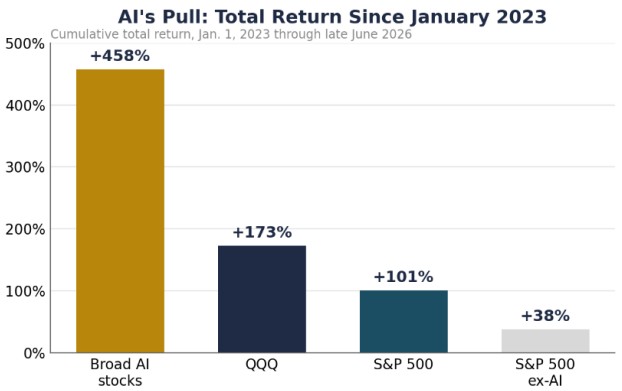
Artificial intelligence has become the swell lifting nearly everything. Since early 2023, a basket of AI related stocks has returned more than 450%, versus roughly 100% for the S&P 500 and just 38% once you strip the AI names out. Momentum, price dispersion, and new stock issuance have all pushed to levels we have not seen since the late 1990s.
Those readings get the word “bubble” thrown around, and history may eventually judge this stretch to have been one. But we are less interested in the label than in what it means for how we invest, and we are not sprinting for the shore. A couple of things keep us in the water.
First, this run is built on far more than a good story. Unlike the profitless concept stocks of the late 1990s, today’s leaders are enormously profitable, with AI and cloud businesses already generating real, fast-growing revenue at healthy margins, and that growth is beginning to broaden to the rest of the market. Second, valuations are not uniformly stretched: one long-term gauge looks extreme, yet against next year’s earnings the market trades near 21 times, elevated but well short of past manias. Higher valuations can be earned, so long as the cash flows keep showing up to back them.
That is also why we diversify, though not by avoiding AI. We want to own the genuine winners of this cycle, the durable, profitable companies actually turning AI into cash flow, while pairing them with holdings that behave differently: lower-volatility positions and areas like healthcare and consumer staples with little connection to the AI trade.
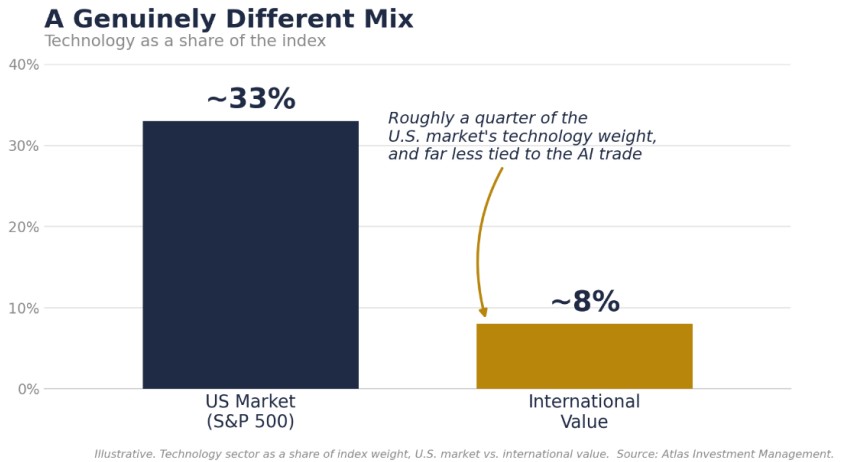
Finding those different currents is harder than it sounds, because AI has reached almost everywhere. Many “value” funds are now stuffed with technology names, and big overseas markets like South Korea and Taiwan are riding the same chips-and-AI story. The exception, and the exposure we have been adding, is international value: it carries only a fraction of the technology weight of the US and genuinely moves to a different drummer.
That is the wave. The tide beneath it is quieter, and it runs through the Federal Reserve.
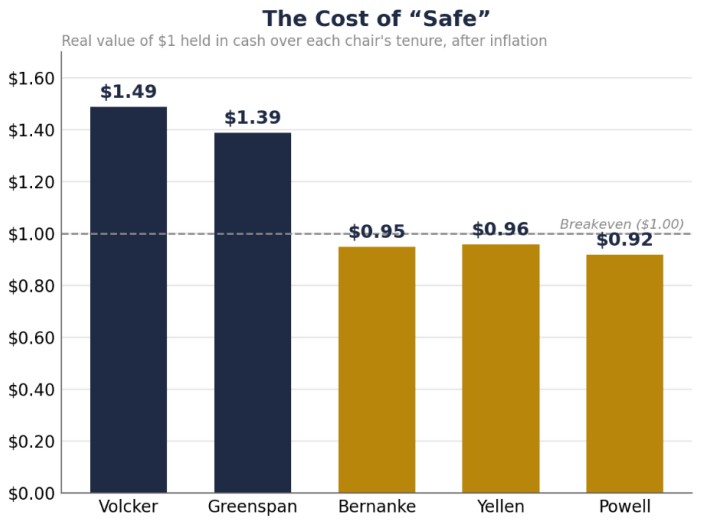
Last month, within days of each other, Alan Greenspan, the chairman once called “the Maestro,” passed away at 100, and Kevin Warsh chaired his first meeting as the new head of the Fed. The useful lesson of the past forty years is that what matters is less the person in the chair than the regime they preside over. Consider a dollar of cash, after inflation: it grew under Volcker and Greenspan but shrank under the three chairs since the 2008 financial crisis. Under Powell, a dollar in cash quietly became about 92 cents, while a dollar in the S&P 500 grew to nearly $1.92. For years, the Fed deliberately kept rates below inflation, and cash slowly lost ground.
Which brings us to today. This spring’s jump in inflation was overwhelmingly an energy story tied to the Middle East conflict, and as that fades, we expect it to ease back toward where it sat earlier this year. The market has swung to pricing rate hikes on essentially one input, the price of oil, and we think it is getting a bit ahead of itself. Our read of the new Chair is that he is data-driven and inclined to look through temporary energy noise, which keeps a supportive rate cut on the table at least as readily as a hike. Even so, with cash barely out-yielding inflation, its cushion is thin: “safe” money is only as safe as the gap the Fed keeps between what cash pays and what inflation takes.
So we do what a good swimmer does: we neither fight the current nor pretend it is not there. In practice, that means staying invested and owning the real winners of the AI build-out, diversifying with intention (including that growing tilt to international value), holding shorterand intermediate-term bonds with an eye on real yields, and resisting both temptations that get swimmers into trouble: sprinting all-in toward the biggest wave, or freezing on the beach in cash while the tide rolls in. This is a moment to be selective, not defensive.
Which brings us back to the water. The mistake at the beach is rarely the wave you can see; it is the current you cannot. Today’s surface is genuinely inviting, with real earnings, improving productivity, and an AI cycle producing genuine profits. Underneath, the rate backdrop is shifting and a new chair is settling in, a reminder that “safe” money in cash is not always as safe as it feels. We are not telling you to stay out of the water, only to swim like someone who respects the current: stay calm, keep your head up, and never mistake a warm surface for a safe one.
That is not fear; it is how experienced swimmers make it home. At Atlas, that discipline is the whole point of our process: diversified portfolios, thoughtful rebalancing, and decisions anchored to your long-term goals rather than to whichever way the water is moving this month.
As always, thank you for the trust you place in us.
June offered a change of character. After months of large-cap and technology leadership, the biggest names took a breather while the rest of the market stepped forward. The S&P 500 slipped 0.95% and the Nasdaq 100 edged down 0.12%, yet small and mid caps pushed higher, with the Russell 2000 up 3.74% and the S&P 400 up 3.54%.
International markets were modestly positive and, for once, held up better than US large caps. Developed international (MSCI EAFE) rose 0.57% and emerging markets gained 0.47%, while broad global equities (MSCI ACWI) slipped 0.45% and ACWI ex-US added 0.17%.
Fixed income was steady. TheUS Aggregate Bond Index rose 0.25% and Treasuries gained 0.30%, while credit was mixed, with high yield up 0.17% and senior loans down 0.38%.
The bigger story is beneath the surface. Year to date, small caps (Russell 2000, +22.6%) and emerging markets (+25.8%) lead, the S&P 500 is up 10.2%, and the Nasdaq 100 has gained 20.3%. After a soft June for the megacaps, breadth is quietly doing more of the work.
As the Chief Investment Officer, Stephen Swensen oversees investment management, research, portfolio design, and all investment-related operations at Atlas. He also chairs the Atlas Investment Committee, guiding strategic investment decisions.
Stephen’s career began as a Financial Analyst for Deseret Mutual Benefits Administration (DMBA), a role in which he managed investments for a private pension fund and insurance company. Subsequently, he served as an investment analyst and portfolio manager for local Registered Investment Advisors (RIAs). Before joining Atlas, Stephen contributed his expertise as an Outsourced Chief Investment Officer (OCIO) for the Carson Group, supporting advisors on the West Coast. Educationally, Stephen holds an MBA and an MS in Investment Management and Financial Analysis from Creighton University. He has earned the Series 65 Uniform Investment Advisor License and is actively pursuing the prestigious
Chartered Financial Analyst (CFA) designation.
Beyond his professional achievements, Stephen is an enthusiastic hockey fan, both on and off the ice. He finds joy in playing the piano, golfing, reading, and outdoor cooking. However, his greatest source of happiness comes from spending quality time with his wife and four children
NOTICE REGARDING INVESTMENT DISCLOSURES: The contents of this memo reflect the opinions of the author(s) as of the indicated date and are subject to change without notice. Atlas Investment Management has no obligation to update the information provided here. It should not be assumed that past investment performance guarantees future results. Potential for profit also entails the risk of loss.
The information presented is believed to be current and is not personalized investment advice. All opinions expressed are as of the date of the presentation and may change over time. All investment strategies carry the potential for profit or loss. Asset allocation and diversification cannot guarantee improved returns or eliminate the risk of investment losses. Target allocations may deviate due to market conditions and other factors. There is no guarantee that any investment or strategy will be suitable or profitable for an investor’s portfolio. Different types of investments involve varying levels of risk.
The charts and slides do not depict the performance of Atlas Investment Management or any of its advisory clients. Historical performance returns for investment indexes and/or categories typically do not factor in transaction and/or custodial charges or an advisory fee, which may decrease historical performance results. There is no assurance that an investor’s portfolio will match or exceed a specific benchmark.
This communication, including any attachments, is intended exclusively for the addressee and may contain proprietary, confidential, or privileged information. Unauthorized use, copying, disclosure, dissemination, or distribution is strictly prohibited. If you are not the intended recipient, please immediately notify the sender by return email, delete this communication, and destroy all copies.
Securities are offered through Purshe Kaplan Sterling Investments, Member FINRA/SIPC, headquartered at 80 State Street, Albany, NY 12207. Investment Advisory services are offered through Ignite Planners, LLC. Purshe Kaplan Sterling Investments and Ignite Planners, LLC are not affiliated companies. Ignite Planners, LLC conducts business only in states where it is properly registered or is excluded or exempted from registration requirements. SEC registration does not constitute an endorsement of the firm by the Commission and does not imply that the advisor has achieved a particular level of skill or ability. All investment strategies carry the potential for profit or loss.