
“Volatility is the price of admission. The prize inside are superior long-term returns. You have to pay the price to get the returns.”
–Morgan Housel, bestselling author of The Psychology of Money and Partner at Collaborative Fund
Volume 32
The Tightrope and the Net
What Happened in the Markets
Subscribe and start receiving the Atlas Memo directly to your email

If you’ve ever seen a tightrope walker, you know the thrill doesn’t just come from the steps across—it comes from the uncertainty. Will they hold their balance? Will the rope sway? The walker’s skill is critical, but so is the safety net below, reassuring the crowd (and the performer) that a slip isn’t the end of the story.
Markets entered the month wobbling near all-time highs. After a late-August technology-led selloff, the S&P 500 and Nasdaq 100 staged only modest rebounds. Gold surged to record highs and silver crossed $40 for the first time since 2011, reflecting investor hedging ahead of what is historically the toughest month for U.S. equities.
September rarely offers smooth sailing. In fact, over the past 50 years, it has been the weakest month for the S&P 500. This year brings an especially heavy calendar: nonfarm payrolls, inflation readings, and the Fed’s September 17 meeting. Each represents a potential gust of wind on the tightrope. Add to that tariff disputes and political questions over Fed independence, and the rope feels more taut than usual.
Yet perspective matters. Strategists at Evercore ISI caution investors not to mistake turbulence for termination. They expect the bull market to continue, with the S&P 500 potentially adding another 20% by 2026. Pullbacks, in their words, are “scares,” not permanent derailments.
At the Jackson Hole Symposium, Jerome Powell effectively told markets: We see the risks, and we’re ready to act. With inflation still sticky and the labor market softening at the margins, Powell signaled that the Fed may cut rates as early as this month.
The numbers explain the dilemma. Core PCE, the Fed’s preferred inflation gauge, rose 0.26% in July (3.3% annualized), with services inflation running even hotter at 3.6%. Durable goods inflation has been influenced by tariff policy, which may prove transitory. However, services—encompassing everything from healthcare to insurance to travel—remain resilient, accounting for more than half of the PCE basket.
Despite this, markets are looking well beyond September. Futures imply six cuts between now and the end of 2026, which would take policy rates below 3%. That’s a dramatic shift from just last December, when markets expected only two cuts in that timeframe. Some of this expectation reflects genuine economic slowing, but part may also reflect political pressure: the current administration has voiced a preference for much lower rates.
The tightrope metaphor comes into focus here: Powell is balancing between inflation that hasn’t yet cooled and an economy that may need relief. Investors are betting heavily that the net will hold—that the Fed will deliver easing even in the face of imperfect inflation data.
If the Fed represents the walker’s arms, investors represent the crowd—sometimes cheering, sometimes gasping. The 2025 State of the American Investor survey reveals that many households remain skeptical about the markets, despite record highs. The scars of pandemic volatility, inflation shocks, and rising housing costs haven’t faded quickly.
And yet, under the surface, participation is broad. Nearly 60% of S&P 500 companies are trading above both their 50- and 200-day moving averages, a signal of healthy breadth. This is not a market narrowly dependent on a handful of mega-cap tech stocks, but one with multiple legs beneath it.
Recent trading data reinforces the point. August closed with a rare “90/90 day,” where 90% of NYSE stocks and volume were positive. Historically, such breadth events have been followed by double-digit forward returns in the year ahead. In fact, the S&P has been higher more than 90% of the time one year after a 90/90 day, averaging over 20% gains.
Animal spirits, in other words, may be more resilient than sentiment surveys suggest. Even when individual investors express caution, the market itself is demonstrating conviction through breadth and participation.
For context, it helps to take a step back. Since its inception in 1957, the S&P 500 has compounded at an annual rate of 10.6%. Since the launch of the first Vanguard index fund in 1976, that number is even better—11.8%. Those returns encompass wars, oil shocks, inflationary spirals, bubbles, busts, and everything in between. Below you can see the decade annualized returns since the 1930s.
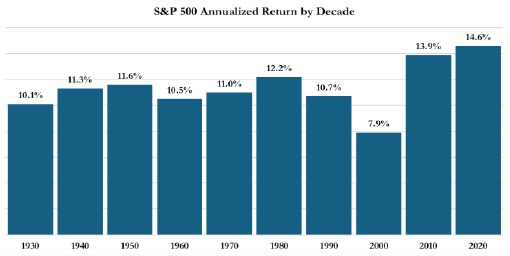
More importantly, the resilience of the index has not been diminished by its growth. While today’s S&P 500 tilts heavily toward technology—roughly 35–50% depending on classification—the long-run returns remain remarkably consistent. Short-term periods vary (the 2000s were lackluster, while the 2010s and 2020s were exceptional), but over decades, the rope always stretches forward, anchored by the net of long-term compounding.
For investors, September may feel like a pivotal moment. Will the Fed’s rate cuts bolster equities further, or will inflation prove too stubborn? Will markets buckle under seasonal weakness, or will broad participation sustain the trend?
Our posture remains balanced, leaning on diversification, respecting volatility, and maintaining steady long-term allocations. Gold’s rise, broad market breadth, and the Fed’s tilt toward easing each serve as reminders that opportunities often emerge when the rope shakes hardest.
So as we step into September, we’re all tightrope walkers, eyes forward, arms outstretched, balancing growth and risk. The rope will wobble—maybe more than usual this month—but beneath us lies the net of history, diversification, and disciplined strategy. That’s the reassurance we lean on, and it’s why we stay on the rope, even when the crowd gasps.
August delivered broad gains across global stocks, with leadership shifting beyond the largest U.S. growth names. The S&P 500 advanced 2.0%, bringing its year-to-date return to just under 11%, while the Nasdaq 100 rose only 0.9%, though it still leads major U.S. indexes for 2025 with a nearly 12% gain. Small caps jumped 7.1% and mid caps climbed 3.4%, signaling improving breadth, though they remain behind at 7.1% and 5.1% year-to-date.
International equities continued their strong run: developed markets gained 4.8% in August and now lead all major categories with a 23% return for the year, while emerging markets rose 2.1% in the month and are up nearly 20% year-to-date. Global equities overall (ACWI) advanced 2.7% in August and sit higher by more than 14% this year, with the ex-U.S. portion up over 21%.
Bonds also posted steady gains. U.S. Treasuries rose 1.0% in August and are up 4.5% year-to-date, while investment-grade bonds gained 1.2% for the month (5.0% YTD). High yield bonds matched that with a 1.2% gain (6.4% YTD), and floating-rate loans were softer but still positive at 0.5% (4.3% YTD). Fixed income overall continues to provide stability, with core bond categories maintaining mid-single-digit gains for the year.
As the Chief Investment Officer, Stephen Swensen oversees investment management, research, portfolio design, and all investment-related operations at Atlas. He also chairs the Atlas Investment Committee, guiding strategic investment decisions.
Stephen’s career began as a Financial Analyst for Deseret Mutual Benefits Administration (DMBA), a role in which he managed investments for a private pension fund and insurance company. Subsequently, he served as an investment analyst and portfolio manager for local Registered Investment Advisors (RIAs). Before joining Atlas, Stephen contributed his expertise as an Outsourced Chief Investment Officer (OCIO) for the Carson Group, supporting advisors on the West Coast. Educationally, Stephen holds an MBA and an MS in Investment Management and Financial Analysis from Creighton University. He has earned the Series 65 Uniform Investment Advisor License and is actively pursuing the prestigious
Chartered Financial Analyst (CFA) designation.
Beyond his professional achievements, Stephen is an enthusiastic hockey fan, both on and off the ice. He finds joy in playing the piano, golfing, reading, and outdoor cooking. However, his greatest source of happiness comes from spending quality time with his wife and four children
NOTICE REGARDING INVESTMENT DISCLOSURES: The contents of this memo reflect the opinions of the author(s) as of the indicated date and are subject to change without notice. Atlas Investment Management has no obligation to update the information provided here. It should not be assumed that past investment performance guarantees future results. Potential for profit also entails the risk of loss.
The information presented is believed to be current and is not personalized investment advice. All opinions expressed are as of the date of the presentation and may change over time. All investment strategies carry the potential for profit or loss. Asset allocation and diversification cannot guarantee improved returns or eliminate the risk of investment losses. Target allocations may deviate due to market conditions and other factors. There is no guarantee that any investment or strategy will be suitable or profitable for an investor’s portfolio. Different types of investments involve varying levels of risk.
The charts and slides do not depict the performance of Atlas Investment Management or any of its advisory clients. Historical performance returns for investment indexes and/or categories typically do not factor in transaction and/or custodial charges or an advisory fee, which may decrease historical performance results. There is no assurance that an investor’s portfolio will match or exceed a specific benchmark.
This communication, including any attachments, is intended exclusively for the addressee and may contain proprietary, confidential, or privileged information. Unauthorized use, copying, disclosure, dissemination, or distribution is strictly prohibited. If you are not the intended recipient, please immediately notify the sender by return email, delete this communication, and destroy all copies.
Securities are offered through Purshe Kaplan Sterling Investments, Member FINRA/SIPC, headquartered at 80 State Street, Albany, NY 12207. Investment Advisory services are offered through Ignite Planners, LLC. Purshe Kaplan Sterling Investments and Ignite Planners, LLC are not affiliated companies. Ignite Planners, LLC conducts business only in states where it is properly registered or is excluded or exempted from registration requirements. SEC registration does not constitute an endorsement of the firm by the Commission and does not imply that the advisor has achieved a particular level of skill or ability. All investment strategies carry the potential for profit or loss.