“Do not anticipate trouble or worry about what may never happen. Keep
in the sunlight.”
–Benjamin Franklin (1706–1790), American Inventor, Statesman, and Writer
Volume 34
The Engine Idles, But It Hasn’t Stalled
The Long View Continues to Look Bright
What Happened in the Markets?
Subscribe and start receiving the Atlas Memo directly to your email

Picture a car idling at a long red light. The engine’s still running, the headlights are on, but it’s not moving forward. That’s roughly where the US government sits today—still functioning but not advancing—during a partial shutdown that began on October 1 after Congress failed to pass a stopgap funding bill for the new fiscal year.
At its core, this standoff isn’t about runaway spending, tax hikes, or the national debt. It’s about one narrow issue: whether to extend enhanced Affordable Care Act (ACA) premium tax credits immediately or debate them later. Both sides agree that the government must reopen—they disagree on the sequence. It’s a procedural fight dressed up as a fiscal one.
Unfortunately, even small instances of political gridlock create very real ripple effects. Roughly 800,000 federal employees are currently furloughed, national parks and museums have closed their doors, and regulatory agencies, such as the SEC, are operating at skeleton capacity—delaying IPOs, compliance reviews, and business approvals. Perhaps most frustrating for investors, the Bureau of Labor Statistics and Bureau of Economic Analysis have paused major data releases, leaving markets temporarily “data blind” on jobs, inflation, and GDP.
Despite the noise, shutdowns like this rarely cause lasting economic damage. The 2018– 19 shutdown—the longest in US history—trimmed GDP by about $11 billion, of which roughly $3 billion was never recovered. This time, economists estimate the hit at about 0.1–0.2 percentage points of GDP per week if the impasse continues, but those losses typically reverse once federal paychecks and spending resume.
What’s new this round is the misinformation. Social media has been abuzz with claims that the shutdown is tied to obscure or “frivolous” spending programs—rhetoric drawn from old talking points, rather than the current negotiations. The truth is far more straightforward: this fight is about ACA subsidies, not pastry classes in Haiti or any of the viral claims circulating online. As fiduciaries, we value transparency and efficiency in government spending—but it’s crucial to separate wasteful anecdotes from fiscal reality. In a $6 trillion federal budget, those small grants amount to pennies on the dollar.
For investors, this is a headline event, not a structural one. Markets may wobble in the short term due to missing data and thinner liquidity, but fundamentals remain strong. Long-term returns depend on corporate earnings, consumer resilience, and rate policy—not political theater. At Atlas, we stay focused and steady. Shutdowns end, markets move on, and the American economy—driven by innovation, productivity, and people—keeps running long after Washington’s stoplights turn green.
If you’ve ever watched a sunrise from the mountains, you know that the light doesn’t flood the valley all at once—it creeps slowly, turning shadows into shape and then into color. That’s how this market feels as we close out 2025: the light is returning, and what once felt uncertain now looks distinctly brighter.
This fall marks three years since Atlas Investment Management opened its doors, and it’s hard not to feel both proud and humbled looking back. In that time, we’ve grown from a vision and a few sleeves of model portfolios into a comprehensive investment platform serving hundreds of families—with discipline, transparency, and clarity of purpose.
And results have followed. Our strategies haven’t just done well this year—they’ve done exceptionally well year-over-year, consistently outperforming their portfolio benchmarks across equity, fixed income, and alternatives. Whether it’s the growth-oriented portfolios capturing upside with measured risk, or the income-driven strategies generating steady returns in a shifting rate environment, our models have proven resilient and adaptable.
Even the more conservative and income-focused portfolios have maintained competitive results while prioritizing stability and capital preservation. It’s not a story of chance—it’s one of process, structure, and a relentless focus on balance.
Despite the constant drumbeat of uncertainty in the headlines, the US economy continues to display an impressive rhythm of resilience. Job growth remains steady, consumer confidence is holding up, and inflation has cooled meaningfully from its highs. Corporate earnings, too, have surprised to the upside. According to FactSet, roughly 80% of S&P 500 companies have exceeded earnings expectations this quarter, marking a clear return to positive profit growth (shown below).
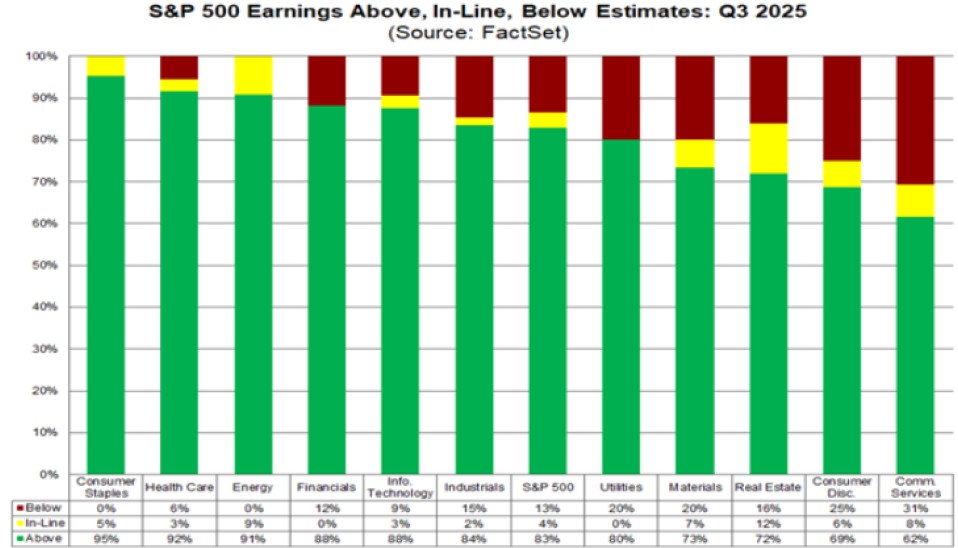
Technology continues to drive innovation and earnings power, but what’s encouraging this time is the breadth of participation—industrials, financials, and consumer sectors are contributing as well. The story is no longer one of a few leaders carrying the market, but of broad, durable progress across industries.
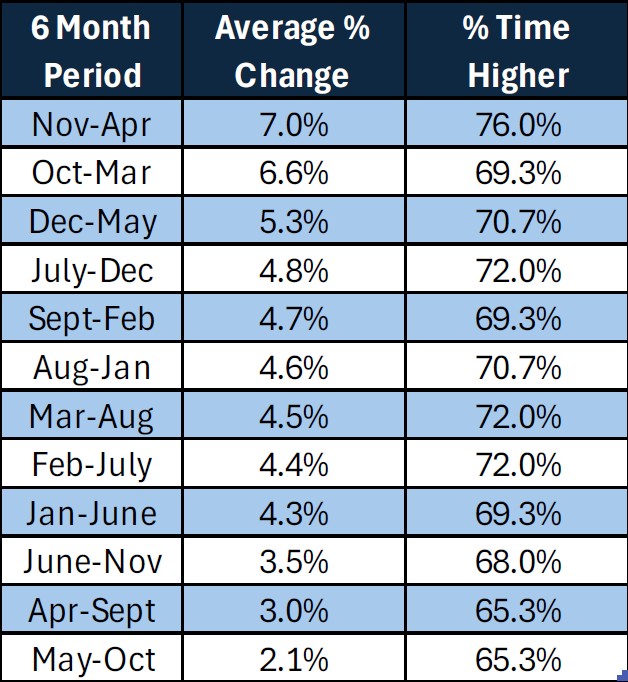
Seasonality is also on our side. November has historically been the start of the market’s strongest six-month stretch, with the November–April period delivering the highest average returns over the past seven decades. Add to that a Federal Reserve that’s shifting from tightening to easing, a decline in interest rate pressures, and the resilience of corporate fundamentals—and the setup for the coming year looks decidedly constructive (see historical data to the right).
Our research even notes that conditions like today—where earnings growth accelerates, inflation normalizes, and monetary policy loosens—have historically paved the way for robust market advances. It’s not prediction; it’s probability. And the probabilities are increasingly pointing toward optimism.
One of the most important lessons this year reinforced is that patience and discipline remain the investor’s best tools. Markets rewarded those who stayed invested and punished those who let headlines influence their decisions. As one of my favorite investment commentators, Ben Carlson, wrote, “Staying the course worked again”.
That mindset is baked into Atlas’ investment process. Each portfolio sleeve is built to perform through market cycles—not around them—by maintaining diversification, adjusting to changing conditions, and never losing sight of long-term objectives. Our focus remains the same: protect on the downside, participate on the upside, and help investors move toward their goals, regardless of the noise.
As Atlas celebrates its third anniversary, I would like to pause and express something simple yet sincere: thank you. To every client who has entrusted us with your capital—thank you for your confidence, your patience, and your partnership. To our advisors—thank you for your dedication, professionalism, and the care you bring to every relationship. You are the bridge between our process and the families we serve.
When we founded Atlas, my personal goal wasn’t just to manage the investments—it was to build a system where fiduciary discipline met genuine human connection. Three years in, that mission feels more alive than ever.
As we turn toward 2026, our optimism isn’t blind—it’s earned. The fundamentals are improving, the data support progress, and our portfolios are positioned to participate in the next phase of growth. The road ahead will always have turns, but the view is clearing. The sun is shining on a resilient market cycle, and Atlas is already climbing toward the light. Here’s to closing a remarkable year and to the bright horizon ahead—together.
October added another strong month for investors, supported by easing inflation pressures, solid earnings, and growing confidence in a softer Federal Reserve stance. The S&P 500 gained 2.3% for the month and is now up 17.5% year-to-date, while the Nasdaq 100 rose 4.8%, extending its 2025 gains to 23.8% as large-cap technology continued to lead. Smaller companies also participated, with the Russell 2000 up 1.8% and mid-caps slightly negative at -0.5%, bringing their year-to-date returns to 12.4% and 5.0%, respectively.
International markets continued to be a source of strength. The MSCI ACWI advanced 2.1% in October and 21.2% year-to-date, led by emerging markets, which gained 3.8% for the month and an impressive 32.6% for the year. Developed international equities also posted gains, with the MSCI EAFE up 0.9% and the ACWI ex-US rising 1.8%.
Fixed income markets contributed modestly as Treasury yields stabilized. The US Aggregate Bond Index gained 0.6% in October and 6.8% year-to-date, while Treasuries added 0.6% for the month and 6.0% year-to-date. Credit sectors were steady, with high yield and senior loans both edging higher.
Overall, October’s results reflected a market regaining its footing—one driven by resilient earnings, cooling inflation, and increasing optimism that the economy is on a path toward a soft landing.
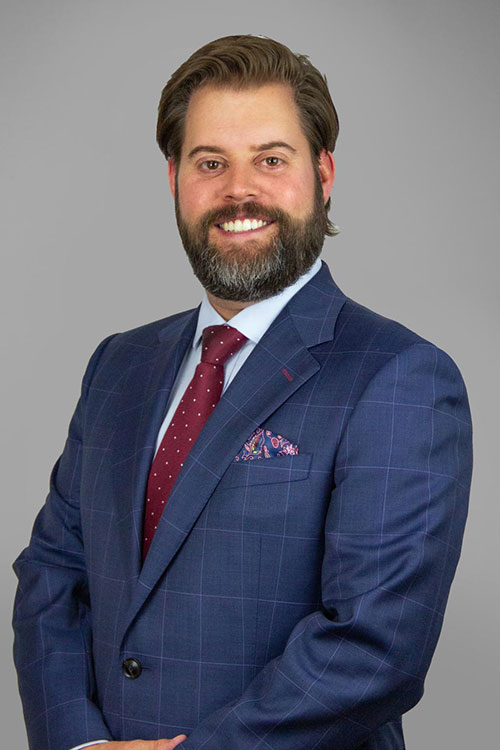
As the Chief Investment Officer, Stephen Swensen oversees investment management, research, portfolio design, and all investment-related operations at Atlas. He also chairs the Atlas Investment Committee, guiding strategic investment decisions.
Stephen’s career began as a Financial Analyst for Deseret Mutual Benefits Administration (DMBA), a role in which he managed investments for a private pension fund and insurance company. Subsequently, he served as an investment analyst and portfolio manager for local Registered Investment Advisors (RIAs). Before joining Atlas, Stephen contributed his expertise as an Outsourced Chief Investment Officer (OCIO) for the Carson Group, supporting advisors on the West Coast. Educationally, Stephen holds an MBA and an MS in Investment Management and Financial Analysis from Creighton University. He has earned the Series 65 Uniform Investment Advisor License and is actively pursuing the prestigious
Chartered Financial Analyst (CFA) designation.
Beyond his professional achievements, Stephen is an enthusiastic hockey fan, both on and off the ice. He finds joy in playing the piano, golfing, reading, and outdoor cooking. However, his greatest source of happiness comes from spending quality time with his wife and four children
NOTICE REGARDING INVESTMENT DISCLOSURES: The contents of this memo reflect the opinions of the author(s) as of the indicated date and are subject to change without notice. Atlas Investment Management has no obligation to update the information provided here. It should not be assumed that past investment performance guarantees future results. Potential for profit also entails the risk of loss.
The information presented is believed to be current and is not personalized investment advice. All opinions expressed are as of the date of the presentation and may change over time. All investment strategies carry the potential for profit or loss. Asset allocation and diversification cannot guarantee improved returns or eliminate the risk of investment losses. Target allocations may deviate due to market conditions and other factors. There is no guarantee that any investment or strategy will be suitable or profitable for an investor’s portfolio. Different types of investments involve varying levels of risk.
The charts and slides do not depict the performance of Atlas Investment Management or any of its advisory clients. Historical performance returns for investment indexes and/or categories typically do not factor in transaction and/or custodial charges or an advisory fee, which may decrease historical performance results. There is no assurance that an investor’s portfolio will match or exceed a specific benchmark.
This communication, including any attachments, is intended exclusively for the addressee and may contain proprietary, confidential, or privileged information. Unauthorized use, copying, disclosure, dissemination, or distribution is strictly prohibited. If you are not the intended recipient, please immediately notify the sender by return email, delete this communication, and destroy all copies.
Securities are offered through Purshe Kaplan Sterling Investments, Member FINRA/SIPC, headquartered at 80 State Street, Albany, NY 12207. Investment Advisory services are offered through Ignite Planners, LLC. Purshe Kaplan Sterling Investments and Ignite Planners, LLC are not affiliated companies. Ignite Planners, LLC conducts business only in states where it is properly registered or is excluded or exempted from registration requirements. SEC registration does not constitute an endorsement of the firm by the Commission and does not imply that the advisor has achieved a particular level of skill or ability. All investment strategies carry the potential for profit or loss.